
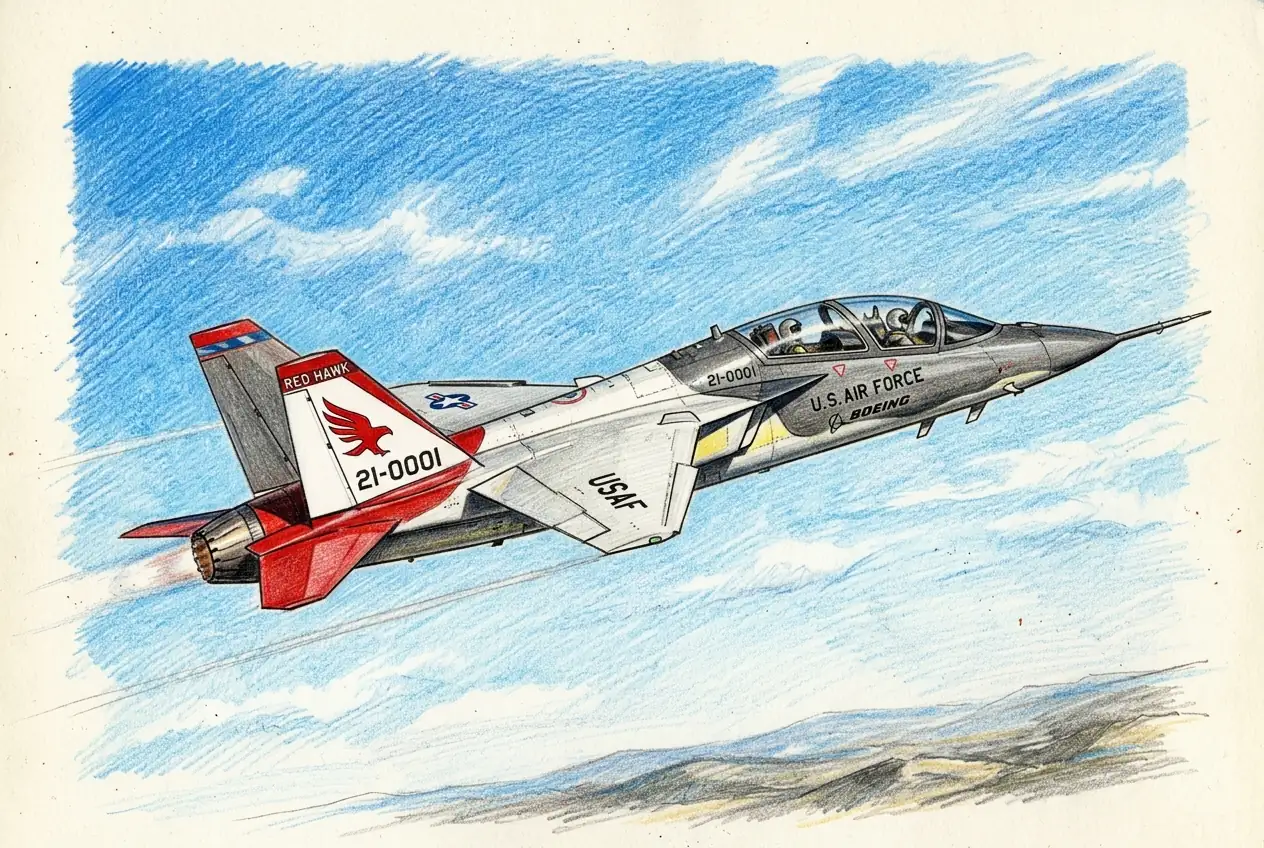
Shares surged as the U.S. Air Force gave Boeing's next-generation jet trainer the green light to move from development into actual manufacturing, a milestone that eases one of the biggest question marks hanging over Boeing's defense portfolio. The stock jumped 4.5% to $234.43, adding roughly $4.5 billion in market value — over 20 times the contract's face value — suggesting investors are pricing in far more than just 14 airplanes. Boeing's Trainer Jet Finally Gets the Green Light — But Does a $219 Million Down Payment Deserve a $4.5 Billion Victory Lap?
Shares jumped 4.5% to $234.43 after the U.S. Air Force cleared Boeing's next-generation pilot trainer for manufacturing, ending years of delays that had cast doubt on one of the company's most important defense programs. The approval is real progress — but the market's euphoric reaction deserves scrutiny.
A $9.2 Billion Pipeline Opens Up, One Cautious Batch at a Time. The Air Force awarded Boeing a $219 million contract to build the first 14 production jets , but this is just the first sip from a much larger well. The full program, awarded in 2018, is worth up to $9.2 billion for 351 aircraft** and 46 simulators.
Budget documents show the Air Force plans to buy 14 jets in fiscal 2026 and 23 in fiscal 2027, ramping to 60 per year by 2030. That ramp is what investors are really buying — a decade of guaranteed revenue. But each of the first three production lots must be approved separately , meaning the pipeline could still slow if testing reveals new problems.
Boeing Has Already Lost Over $1.8 Billion on This Program. The production green light comes after years of schedule delays under a fixed-price contract plagued by ejection seat problems, flight-control software issues, and supply chain disruptions — with Boeing's cumulative losses exceeding $1.8 billion.
The Air Force originally planned to buy operational jets in 2023; that deadline slipped three times. The transition to production should improve margins — development losses are sunk costs — but Boeing must still prove it can build these jets profitably at scale.
The Export Opportunity May Be the Real Prize. Boeing aims to sell over 2,700 of these trainers globally.
The company is marketing the jet to Brazil, Japan, and the United Kingdom , where aging trainer fleets need replacement. If even a fraction of that international demand materializes, the revenue base grows far beyond the Air Force contract — but no foreign orders have been signed yet.
The Stock's Reaction Looks Generous. Boeing's market value rose roughly $4.5 billion on a $219 million contract — a 20-to-1 ratio that only makes sense if investors are pricing in the full program plus exports and improved execution. The full fleet isn't expected to be complete until 2036. With broad market tailwinds (S&P 500 futures up 0.93%) amplifying the move, today's price reflects optimism that Boeing's troubled defense unit has finally turned a corner. Whether that bet pays off depends on something Boeing hasn't yet demonstrated: delivering complex military hardware on time and on budget.