
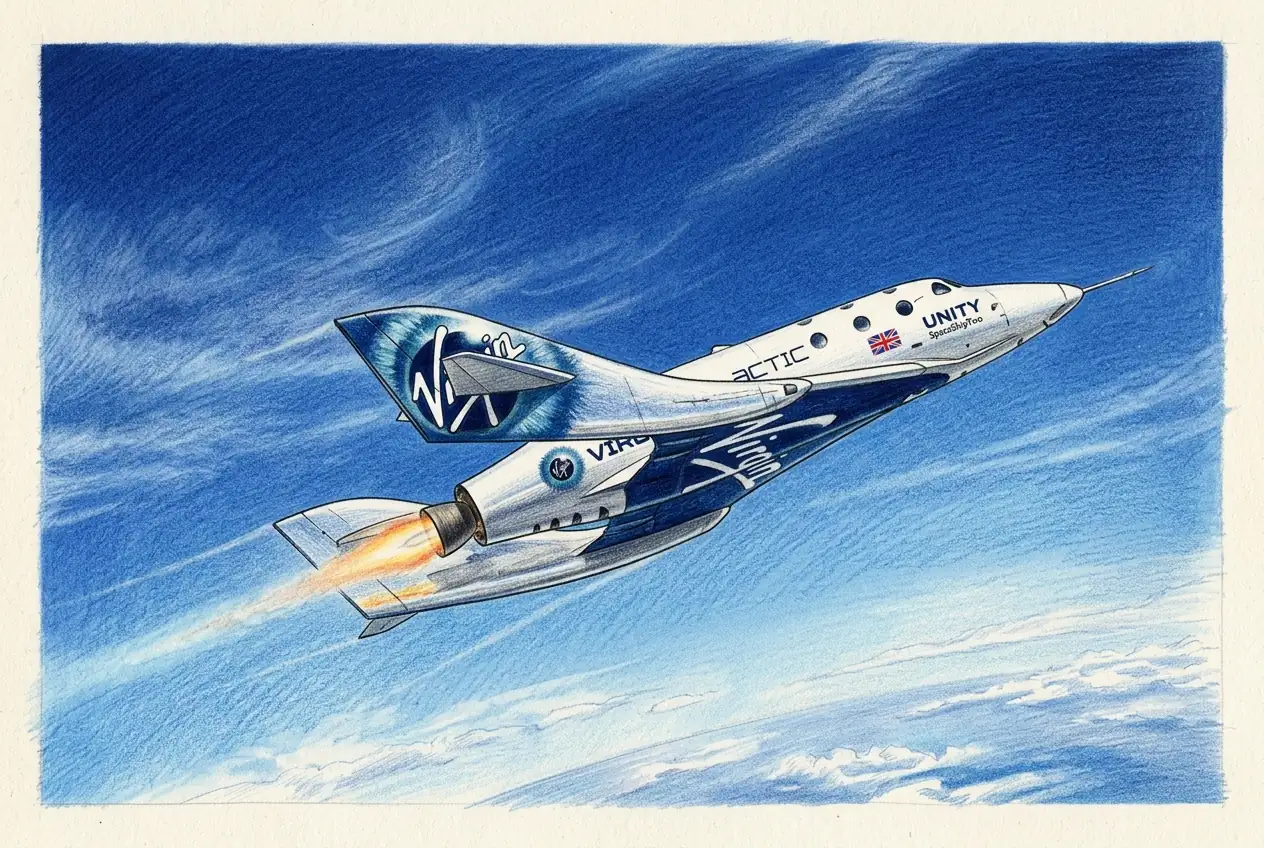
Shares shifted sharply as Virgin Galactic put its retired spacecraft back in the air for the first time since June 2024, igniting a rally that has nearly doubled the stock in under two weeks. The company announced that its prototype spaceplane returned to the skies above Spaceport America in New Mexico for glide flights designed to train pilots and ground crews ahead of next-generation spacecraft operations. At $4.77, SPCE is up +73% from its $2.75 close just six trading days ago — a move amplified by a rival's misfortune and broader space-sector enthusiasm.
A Retired Spacecraft Doubles as a Training Tool — and a Confidence Signal. Virgin brought VSS Unity back into service because its flight characteristics closely match the upcoming Delta-class vehicle.
The company expects Delta glide tests in Q3 2026 and rocket-powered flights to space in Q4, with the new ships designed to fly twice per week over a 500-mission lifetime. For shareholders, each successful flight shrinks the risk that the Q4 commercial launch target slips again — a pattern that has haunted this stock for years.
Blue Origin's Explosion Handed Virgin Galactic a Competitive Gift. Blue Origin's New Glenn rocket exploded during a ground test at Cape Canaveral, triggering regulatory scrutiny and potentially delaying its launch ambitions — giving Virgin Galactic's different launch approach a perceived safety advantage.
SPCE jumped over 12% in Friday's premarket alone, extending a weekly rally of more than 39%.
The Financials Are Still Brutal. Total operating expenses fell to $66 million from $89 million a year earlier, and net losses narrowed from $84 million to $65 million in Q1. But free cash flow was negative $93.3 million , and the company has roughly $220 million in cash and short-term investments — enough runway for perhaps two to three more quarters at current burn. Management reopened ticket sales at $750,000 per seat for about 50 flights , but meaningful revenue won't arrive until paying passengers actually fly.
Wall Street Is Split, and the SpaceX IPO Cuts Both Ways. Jefferies maintains a Buy with a $5 target , while the broader consensus is Hold, with two Buys, three Holds, and one Sell among six analysts.
SpaceX's IPO filing at a reported $1.75 trillion valuation has lifted all space stocks — but once SpaceX lists, capital may rotate out of smaller names like SPCE. The rally is real, but the business case still rests entirely on a Q4 deadline that this company has never met before.