
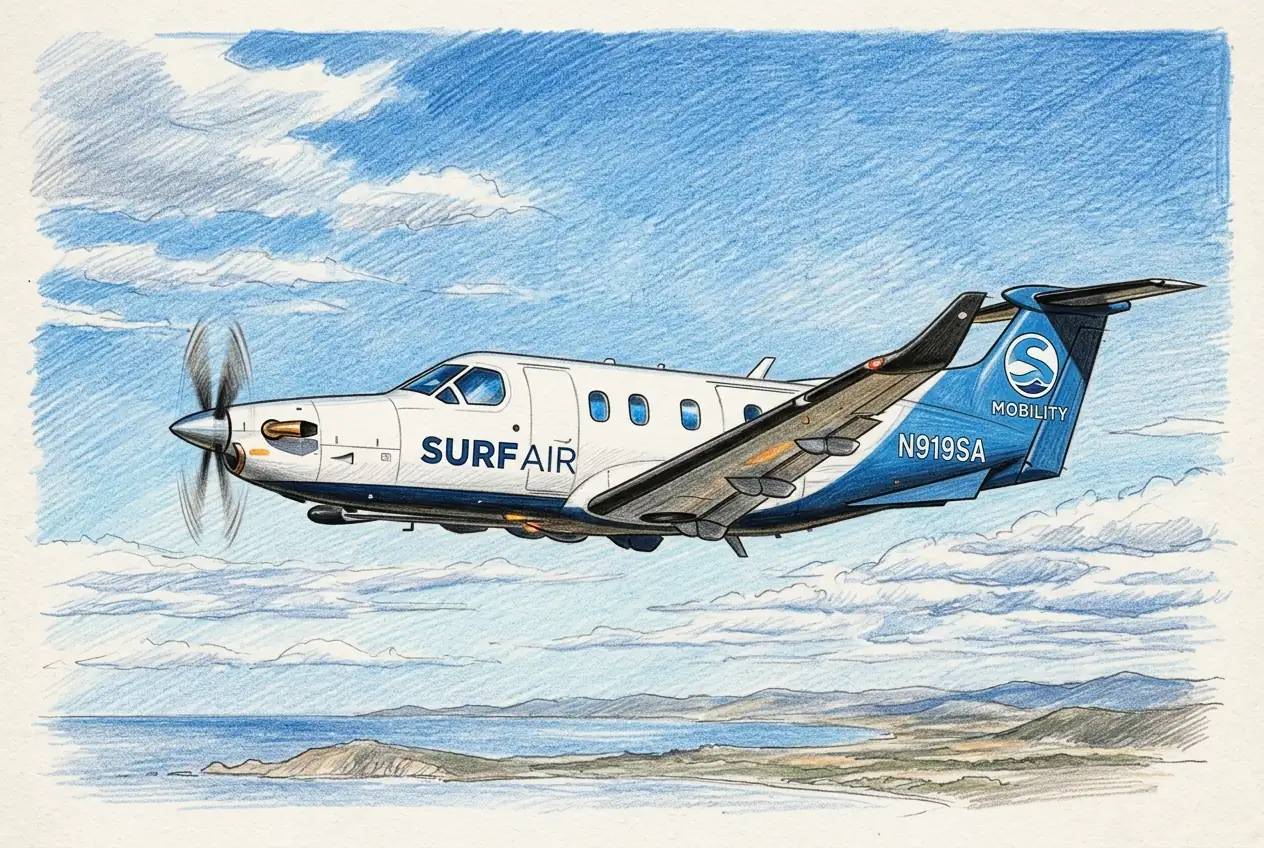
Shares of Surf Air Mobility jumped 14% to $0.57 on September 17 after the company signed a commercial contract with Sprintbach Aviation for its flight-operations software — a platform built with Palantir Technologies that handles scheduling, crew management, and reporting for small charter airlines. The definitive agreement marks the official commercial launch of the product and a step toward the company's goal of five operators live on the platform by the end of 2026. For a stock that has shed more than half its value in the past year, the question is whether this milestone signals a genuine business-model shift or just another headline for a cash-strapped micro-cap.
- The First Paying Customer Is Tiny. Sprintbach currently operates 9 aircraft with 16 pilots on staff.
Surf Air Mobility will earn a percentage of revenue for all Sprintbach flights managed through the software. No contract value was disclosed. A revenue-share on a nine-plane fleet is unlikely to register on a company that reported Q1 2026 revenue of $25.6 million. The deal matters more as proof-of-concept than as a profit driver.
- The Losses Dwarf the Opportunity — For Now. In the last 12 months, operating cash flow was negative $64 million and free cash flow was negative $70 million.
The company holds just $12.67 million in cash against $100.58 million in debt. Even if all five targeted operators sign on by December, their combined revenue-share fees would be a rounding error on that burn rate. Management is betting that software income — which carries far higher profit margins than flying airplanes — can eventually reshape the economics, but execution risk remains extreme.
-
Palantir's Backing Adds Credibility, Not Certainty. Palantir now holds 8.25 million shares — a 7.4% stake — and has committed dedicated resources to accelerate product development under an expanded partnership. A prior deal with Wheels Up, a 2–3 year software contract expected to bring in up to $12 million in subscription revenue, shows the platform can attract larger names. But SRFM's market cap sits around $44 million at today's price, and its share count has increased 172% in one year through dilutive fundraising — meaning existing shareholders have been paying the bill.
-
The Stock Moves on Headlines, Not Earnings. SRFM spiked 17% on the Palantir expansion in July and is up 14% today. Yet the stock has declined 56% over the past 52 weeks. Each software announcement triggers a pop that quickly fades, reflecting a market that rewards narrative but demands proof of recurring revenue before assigning lasting value. Until the software generates meaningful, measurable cash flow, today's rally looks like another chapter in that pattern.