
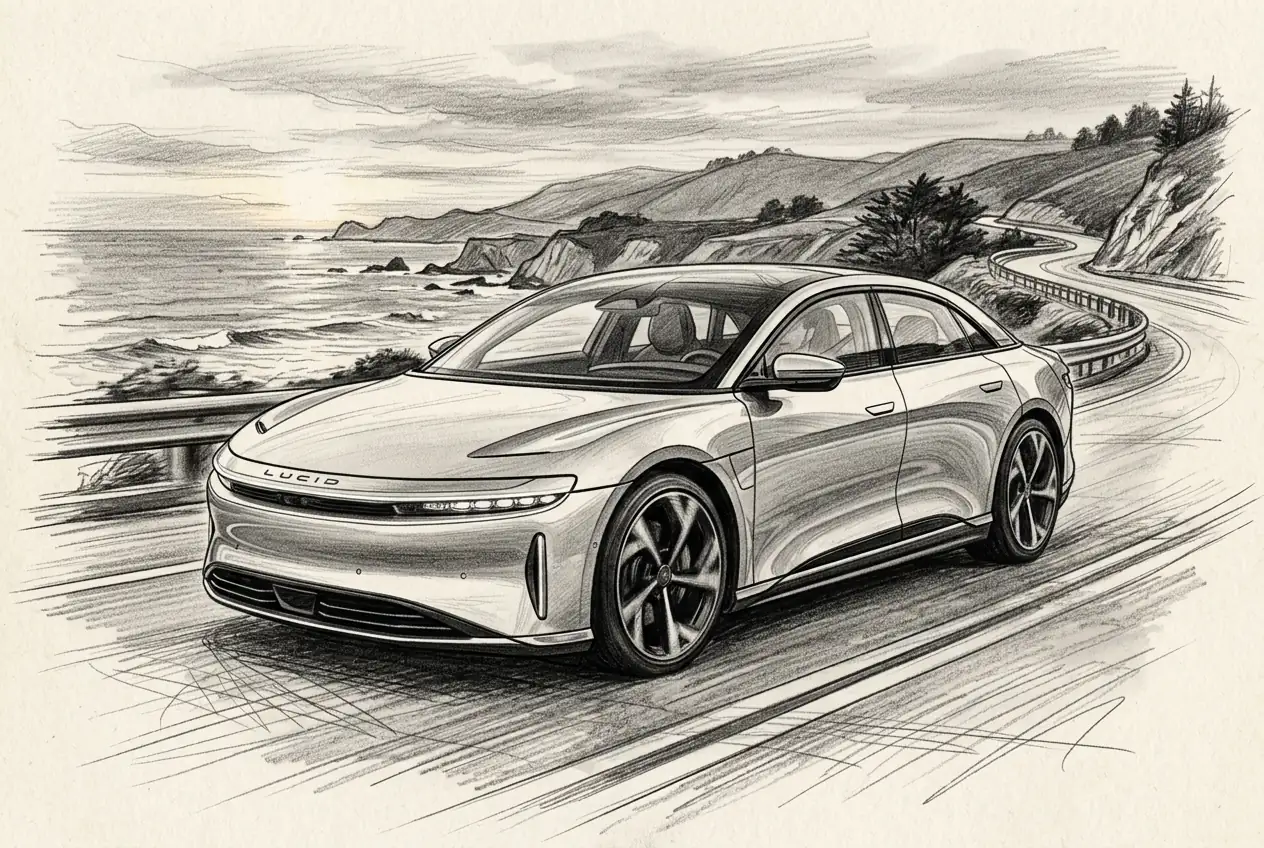
Shares of Lucid Group surged 10.5% to $4.46 after the company announced a partnership with European ride-hailing platform Bolt to develop and deploy at least 25,000 autonomous vehicles across Europe — a headline that electrified a stock that had been drifting lower all week from $4.22 to $4.04. The rally also caught a tailwind from a broader Nasdaq advance of 1.28%, but the size of the move suggests investors see something company-specific here. Lucid and Bolt Promise 25,000 Self-Driving Cars for Europe — Can a Company Burning $1 Billion a Quarter Actually Build Them?
Shares of Lucid Group jumped 10.5% to $4.46 after the electric-vehicle maker announced a partnership with Bolt, Europe's largest ride-hailing platform, to co-develop and deploy at least 25,000 autonomous vehicles across the continent. The deal landed on a strong tape — the Nasdaq was up 1.28% — but the spike mostly reflects investors betting this partnership could reshape Lucid's business model from a niche luxury carmaker into a supplier of self-driving fleet vehicles.
• Bolt Is a Legitimate Partner, but the Timeline Is a Question Mark. Bolt operates in over 50 countries and 850 cities with more than 200 million customers and 4.5 million drivers.
The company says the 25,000 vehicles are "a major step" toward a bigger goal: 100,000 autonomous vehicles on its platform by 2035. That's credible scale — but neither company gave a deployment date for the fleet. Without a timeline, investors are pricing in a vision, not a contract.
• Lucid's Factory Can't Support This Yet. On August 4, Lucid delayed its Midsize vehicle program — the very platform these autonomous cars would be built on. The company cut 18% of its workforce, about 1,500 jobs, withdrew its 2026 production guidance, and delivered just 3,953 vehicles in the second quarter. Building 25,000 fleet cars requires manufacturing capacity Lucid does not currently possess.
• The Cash Burn Makes Every Promise Expensive. During Q2, operating losses totaled nearly $1.1 billion, up from around $800 million a year earlier, while operating cash burn topped $1.2 billion.
Saudi Arabia's Public Investment Fund remains Lucid's majority shareholder and deep-pocketed backer, but the company is burning over $1 billion per quarter with just $3 billion in total liquidity.
Further PIF support means further share dilution — Lucid's share count grew from 327.7 million to 394.1 million in just six months, watering down any upside.
• Bolt Is Hedging Its Bets Across Multiple Automakers. Bolt also has a strategic partnership with Stellantis to explore large-scale deployment of driverless vehicles, with a goal of 100,000 autonomous vehicles by 2035 — the same target cited in the Lucid deal. That overlap suggests Lucid is one option among several, not an exclusive supplier.
The stock's reaction is understandable: 25,000 vehicles would dwarf Lucid's entire annual output. But with no financial terms, no delivery date, and a Midsize platform still in prototype, this is a bet on a future that remains, as CEO Silvio Napoli himself conceded, a place where "potential is not performance."